
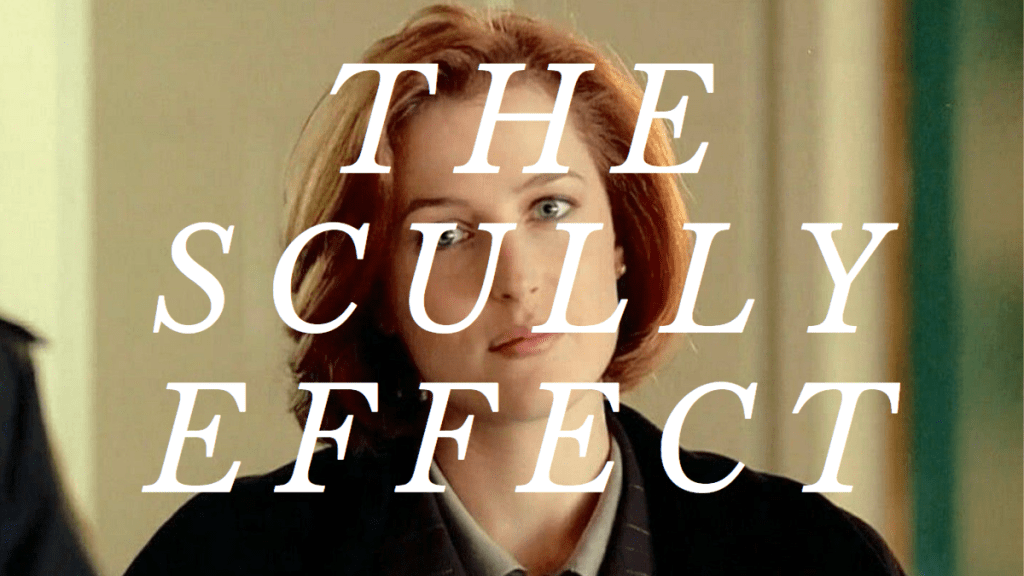
If you asked me years ago if a TV character could fundamentally alter the career trajectory of an entire generation of women, I would have laughed. I mean, I love media. I’ve written before about how experiences, even gaming or travelling, shape us. But single fictional characters changing the demographics of science and technology? It sounds like a plotline from a sci-fi show.
But as it turns out, the truth really is out there.
It’s called The Scully Effect, and it’s a fascinating look at how the stories we consume don’t just entertain us—they wire our brains for what we believe is possible.
For those of us walking the long road ahead—whether that’s recovering from a stroke, navigating mental health struggles, or just trying to figure out who we are—there is a powerful lesson here about the importance of seeing the strength we want to embody.
The Landscape of 1993
Let’s rewind to the early ’90s. The internet was a baby. I was… well, I wasn’t even around yet. But the cultural landscape was very different. If you turned on the TV and looked for a scientist, you saw a very specific archetype:
- Male
- White
- Usually wearing a lab coat
- Socially awkward
- Probably holding a beaker that was smoking for no reason
Then, on September 10, 1993, The X-Files premiered. And with it came Special Agent Dana Scully.
Played by Gillian Anderson, Scully wasn’t just the sidekick to the ‘believer’ Fox Mulder. She was the sceptic, a medical doctor, and a role model for women and minorities. She was hyper-competent, rational, and didn’t take any nonsense. In a world of aliens and conspiracies, she was the anchor of logic.
And for millions of young women watching, a lightbulb went on. Wait. I can be that?
The Data: More Than Just an Anecdote
This is where we get into the James Clear-style breakdown. It’s easy to say “representation matters” as a fuzzy, feel-good slogan. It’s another thing to back it up with hard data.
For years, Gillian Anderson would mention at Comic-Con panels that girls would come up to her and say they became doctors or physicists because of Scully. It was anecdotal. But in 2018, the Geena Davis Institute on Gender in Media decided to actually measure this phenomenon.
They conducted a study titled “The Scully Effect: I Want to Believe… in STEM”. The results were staggering.
The Key Findings:
- 63% of women familiar with Scully said she increased their confidence that they could excel in a male-dominated profession.
- 91% of women familiar with Scully considered her a role model.
- 50% of these women said Scully increased their interest in STEM (Science, Technology, Engineering, and Math).
- Women who regularly watched The X-Files were 50% more likely to work in a STEM field than those who didn’t.
Let that sink in. Watching a fictional character dissect aliens and roll her eyes at her partner didn’t just make for good TV—it actually helped funnel talent into the scientific workforce.
Why Does This Happen? (The Psychology of “Seeing is Believing”)
So, why does this work?
As I’ve written about in my posts on stroke recovery and life experiences, our brains are constantly looking for patterns to help us navigate the world. When we are young (or even when we are rebuilding ourselves after a trauma), we look for blueprints.
If you’ve never seen someone “like you” doing “that thing,” your brain categorises “that thing” as Not For Me.
This is what psychologists call Social Cognitive Theory. We learn not just by doing, but by observing. When a young girl in 1995 saw Scully performing an autopsy or challenging a powerful man with scientific evidence, her brain registered a new possibility.
It’s the same reason I find value in listening to people like Steven Bonnell (Destiny) or Slavoj Žižek debate. It’s not just about the content; it’s about observing the method of thinking. It expands the toolkit you have available in your own head.
In my own life, becoming a stroke survivor at 22, I found myself desperately looking for examples of young people who had recovered. I needed a Scully. I needed to see that the road ahead, while long, was walkable. When you don’t have a model, you’re hacking through the jungle with a machete. When you do have a model, you’re driving on a paved road. It’s still hard, but you know where you’re going.
Reality Check
Now, let’s be real for a second.
It’s easy to look at the Scully Effect and think, “Great! We put a woman in a lab coat on TV, and sexism is solved!”
No.
That’s not how this works. Representation is the spark, not the fuel.
- The Spark: Seeing Scully makes a girl think, “I could be a physicist.”
- The Fuel: Affordable education, non-toxic work environments, fair pay, and structural support.
Scully can get you into the lecture hall, but she can’t pay your tuition or stop your male professor from talking over you.
However, we shouldn’t underestimate the spark. You can’t build a fire without it. The “Scully Effect” proves that culture is a massive lever for change. It challenges the “boys’ club” mentality not by preaching, but by simply existing. Scully wasn’t walking around holding a sign saying “Girls Rule.” She was just… being a boss. She was doing the work.
That’s a lesson for us, too. Sometimes the most powerful thing you can do—whether you’re recovering from an illness, fighting a mental health battle, or breaking a glass ceiling—is to just show up and do the work. Your existence is proof to someone else that it’s possible.
The Long Road Ahead for STEM
We are decades past the premiere of The X-Files, but the STEM gap persists.
- Women make up nearly half of the workforce, but only about 27% of STEM workers.
- The numbers are even lower for engineering and computer science.
The road ahead is still long. We need more Scullys. And not just in science. We need Scullys for disability. We need Scullys for mental health. We need characters who show us that being “broken” or “different” doesn’t mean you can’t be the hero of the story.
When I was lying in that hospital bed, paralysed on my left side, wondering if I’d ever walk again, I wasn’t thinking about statistics. I was thinking about survival. But looking back, I realise how much I relied on the stories I’d consumed to keep me going. I relied on the idea that “recovery” was a narrative arc that was possible for me.
How to Apply the “Scully Effect” to Your Life
You might not be a TV writer, and you might not be going into STEM. But you can still use this principle.
- Curate Your Inputs: Just like I wrote about in “Experiences: Do They Shape Us?”, what you consume matters. If you want to be more resilient, read books by resilient people. If you want to be wittier, watch smarter comedy. If you want to understand the world, listen to debates that challenge you.
- Find Your Scully: Whatever challenge you are facing—stroke recovery, a career change, a breakup—find someone who has done it before. Read their biography. Watch their interviews. Let their reality become your blueprint. For me, it’s Sherlock Holmes, Jeremy Brett and Jonny Lee Miller.
- Be The Scully: This sounds cheesy, but it’s true. You have no idea who is watching you. You have no idea who is drawing strength from the fact that you are still standing.
Final Thoughts
The Scully Effect is a reminder that the boundary between “fiction” and “reality” is thinner than we think. We make our stories, and then our stories make us.
Dana Scully was a fictional character. She didn’t actually solve any crimes or perform any autopsies. But the doctors she inspired? They are real. The cures they are finding? They are real. The engineering breakthroughs they are making? They are real.
Little did the writers know in 1993 that by writing a character who searched for the truth, they would actually help create a better version of it.
If you enjoyed this post, please give me a like, follow, and turn on notifications. It helps more than you know.
 The Long Road Ahead
Leave a comment