
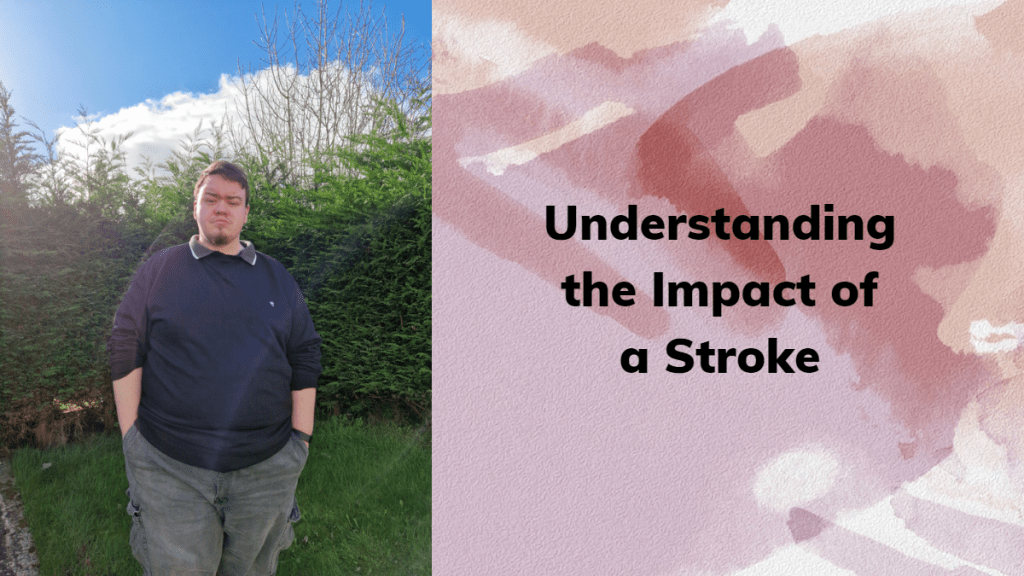
Seven years ago, the universe decided to play a very dark, very confusing practical joke on me.
I was 22 years old. I was healthy. I was almost as invincible as any 22-year-old assumes they are. I was worried about typical 22-year-old things: career paths, dating, and whether I could afford that second drink at the bar.
I did not worry about my vascular system. I did not worry about the structural integrity of my brain tissue.
In my mind—and likely in yours—a stroke was something that happened to your Great Aunt Edna while she was knitting doilies. It was an “Old Person Event,” tucked away in the filing cabinet of life under “Things to Worry About in 2070.”
But I was wrong. The universe doesn’t care about your filing system.
A blood clot formed. It took a detour, parked itself in my brain, and effectively cut the power to a specific district of my mind. It starved my cells of oxygen and nutrients. When the lights came back on, the wiring was fried. I had lost motor function on the left side of my body.
I was a stroke survivor at an age when most people are just trying to survive their first entry-level job.
Recovering from this wasn’t just a medical event; it was a philosophical one. It forced me to look at the “Long Road Ahead”—not as a scary path to avoid, but as the only path there was.
If you are reading this because you or a loved one is in the thick of it, or if you’re just a human being trying to navigate the messy business of being alive, I want to share what I’ve learned. Not just the medical stuff, but the deep, weird, sometimes funny, often frustrating reality of understanding the impact of a stroke.
The “Check Engine” Light You Can’t Ignore
In the world of self-improvement (looking at you, James Clear), we talk a lot about “systems.” We optimise our morning routines, our gym schedules, and our productivity workflows.
But what happens when the hardware running those systems crashes?
At first, I didn’t accept it. I was in deep, profound denial. It felt like a computer error—a temporary “Blue Screen of Death” that a simple restart would fix. Surely, I thought, I’ll wake up tomorrow, and my left arm will remember how to be an arm again.
It didn’t.
This is the first stage of stroke recovery: The collision between your expectation of how the world works and the cold, hard reality of biology.
The impact wasn’t just that my arm wouldn’t move; it was that my identity had been fractured. I was “The Healthy Guy.” Suddenly, I was “The Patient.” Bridging that gap requires a level of mental gymnastics that no one prepares you for.
The Toddler Phase (Revisited)
One of the most jarring impacts of a stroke is the sudden, violent loss of independence.
Imagine you are a highly complex operating system, capable of complex thought, humour, and ambition. Now, imagine you are installed in hardware that operates with the grace of a malfunctioning robot vacuum.
I had to relearn the basics. And I don’t mean “relearning calculus.” I mean getting dressed. Tying my shoes. Brushing my teeth.
There is a specific kind of humbling fury that comes from struggling to tie a shoelace at the age of 22. It’s a task you mastered when you were five. Your brain knows how to do it. The theory is there. But the signal isn’t getting through.
The Feedback Loop of Frustration
In psychology, there is a concept called the “Gap.” It’s the distance between your taste (what you want to produce) and your ability (what you can actually do). Usually, this applies to artists or writers. For a stroke survivor, the Gap is physical.
- The Intent: “I will pick up this toothbrush.”
- The Action: Hand twitches, misses the toothbrush, knocks over the cup.
- The Result: Anger.
However, this phase taught me the most important lesson of my life, one that echoes the sentiment of “atomic habits.” Progress is not a straight line. It is messy, jagged, and slow.
I learned that I couldn’t focus on the goal (“Be normal again”). That goal was too big; it was crushing me. I had to focus on the system (“Move finger one inch”).
If you are on the long road ahead, you have to fall in love with the boredom of repetition. You have to embrace the toddler phase. You are rebuilding the neural highways in your brain, one paver at a time. It is tedious. It is unsexy. But it is the only way forward.
The Social Elephant in the Room
Here is the part people don’t like to talk about in glossy medical pamphlets. A stroke changes your address book.
Human beings are generally good people. But human beings are also terrified of mortality. When a young, healthy person suddenly breaks, it scares the hell out of everyone around them. It reminds them that they are fragile, too.
After my stroke, the dynamic shifted.
- The Avoiders: Some people just vanished. They didn’t know what to say, so they said nothing.
- The Baby-Talkers: Others swung the opposite way. They spoke to me louder and slower, as if the blood clot had erased my intellect along with my motor function. (Note: My speech was fine. My IQ was acceptable. My patience, however, was thinning.
I struggled with a profound sense of isolation. I felt like I was watching the world through a thick pane of glass. Everyone else was moving at 60mph, and I was stuck in first gear.
The Reality Check
Here is the harsh truth I had to swallow: It’s not about me.
People’s reactions—the awkwardness, the distance, the pity—were about their inability to process trauma. It wasn’t that I was unlovable; it was that I was a walking mirror of their own vulnerability.
Once I realised this, the resentment started to fade. I stopped expecting people to be perfect mind-readers. I started communicating my needs more clearly. “I don’t need you to fix me; I just need you to hang out and watch a movie with me.”
If you are a stroke survivor, you will lose some people. But you will also discover who your “ride or die” friends are. The ones who stick around when things get messy? Those are the only ones that matter.
The Compound Interest of Recovery
Let’s get back to the good stuff—the “James Clear” side of things. How do we actually get better?
We treat recovery like compound interest.
In finance, a 1% gain doesn’t look like much today. But over seven years? It’s massive. In stroke recovery, a 1% improvement in range of motion feels pathetic on a Tuesday. You might spend a week trying to get your thumb to touch your pinky. It feels futile.
But let’s look at the math of resilience:
- Neuroplasticity: Your brain is plastic. It is designed to change. When one road is blocked (the stroke), the brain can hack a new path through the forest.
- Repetition: The machete you use to hack that path is repetition.
- Time: The path doesn’t become a highway overnight.
I had to learn to zoom out. I stopped comparing myself to “Pre-Stroke Me” (that guy was gone). I started comparing myself to “Yesterday Me.”
- Did I move slightly better than yesterday?
- Did I handle that awkward social interaction better than last week?
- Did I manage my fatigue better?
If the answer was yes, I was winning.
Self-Care: Maintenance for a Broken Machine
Before the stroke, “self-care” sounded like something for people with too much time and money. It meant spa days and cucumber water.
After the stroke, self-care became a survival tactic. It became an engineering requirement.
When your brain is healing, it is consuming a massive amount of energy. You are running a marathon while sitting on the couch. I learned—the hard way—that if I didn’t fuel this machine correctly, it would stall.
- Sleep is not a luxury; it is a repair cycle. I had to stop feeling guilty for needing naps. That wasn’t laziness; that was my brain knitting itself back together.
- Diet is fuel. Putting junk into a system that is already struggling is like putting sand in a gas tank.
- Mental diet matters. Stress is toxic to a healing brain. I had to ruthlessly curate what I worried about.
This is a lesson for everyone, not just stroke survivors. We treat our bodies like rental cars we’re trying to run into the ground. But you only get one chassis. Treat it with some respect.
The Hopeful Conclusion
So, why am I writing this? Why revisit the trauma?
Because seven years later, I can look at the impact of my stroke and see something other than loss.
Don’t get me wrong—I wouldn’t recommend having a stroke. Zero stars. Would not Airbnb this body again.
But… it woke me up.
It stripped away the arrogance of youth. It forced me to slow down and look at the world. It taught me that patience isn’t just waiting; it’s an active state of endurance. It taught me that independence is a privilege, not a right.
Most importantly, it taught me that we are stronger than we think.
We humans, are terrified of change. We draw a picture of how our life is supposed to go (school, job, marriage, retirement, death), and when the universe scribbles over that drawing with a black marker, we panic.
But the scribbles are where the real life happens.
If you are navigating the long road ahead, know this:
- You are not your stroke. You are the consciousness observing it.
- The plateau is part of the climb. When it feels like you aren’t improving, you are simply laying the foundation for the next leap.
- You are not alone. There is a massive, silent army of us out here. We are the ones walking a little slower, celebrating the small wins, and understanding the fragility and beauty of this weird thing called life.
The impact of a stroke is heavy. It changes the landscape of your world. But landscapes can be rebuilt. Paths can be rerouted. And sometimes, the view from the new road—while different from the one you planned—is still pretty spectacular.
Keep walking.
Key Takeaways for the Road Ahead:
- Acceptance First: You cannot hack a system you are in denial about. Acknowledge the glitch so you can start the repairs.
- The 1% Rule: Focus on microscopic improvements. They compound over time.
- Curate Your Circle: It’s okay to distance yourself from people who drain your limited energy. Surround yourself with those who support your recovery.
- Reframe Self-Care: It isn’t indulgence; it’s necessary maintenance for high-performance recovery.
- Trust the Plasticity: Your brain wants to heal. Give it the time, repetition, and patience it needs to find the new way.
 The Long Road Ahead
Leave a comment