
When the Silence Gets Loud
There is a specific kind of silence that settles in after the hospital doors slide shut behind you. In the hospital, there’s noise. Beeping monitors, the squeak of nurses’ shoes, the constant prodding and testing. You are a “patient.” You have a job: survive. But when you get home, the noise stops. You are left with the four walls of your bedroom, a body that doesn’t quite respond the way it used to, and a mind that suddenly feels like a stranger’s house.
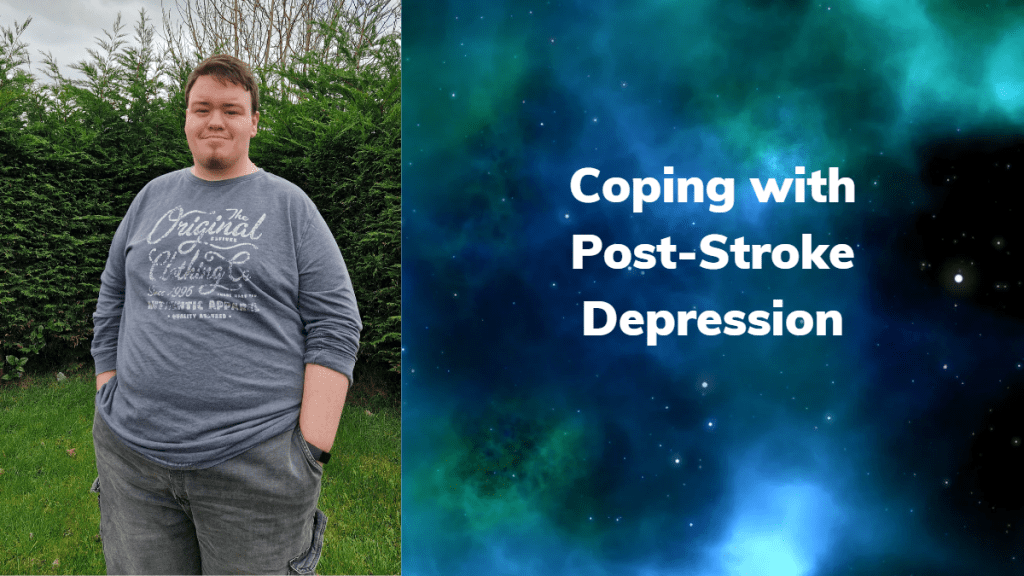
I was 22 years old when my brain decided to hit the reset button. A haemorrhagic stroke. Bam. Just like that, the script of my life—which I thought was a comedy or maybe an adventure movie—suddenly turned into a gritty survival drama.
For a long time, I didn’t talk about the darkness that followed. I spoke of the physical rehab. I talked about learning to walk again. I talked about the fight. But I didn’t talk about the Fog.
Post-stroke depression isn’t just “feeling sad.” It’s not just having a bad day because you dropped your coffee cup (though, let’s be honest, that is infuriating when your left hand is on strike). It is a heavy, suffocating blanket that dampens the world. It’s the feeling that the “real” you died in that hospital bed, and this new version—this slower, tireder, broken version—is an imposter.
I want to talk about that today. I want to take you through the melancholy, the “everything is f*cked” phase, and show you how I eventually found the light. Because, spoiler alert: the light does get in.
Part I: The Science of the Slump (Or, Why Your Brain is Being a Jerk)
If you are reading this and you are a stroke survivor feeling like you’re wading through treacle, I need you to understand one thing immediately: You are not weak. You are injured.
James Clear often talks about the difference between motion and action, but in stroke recovery, we have to talk about biology vs. psychology.
Research indicates that approximately 33% of stroke survivors experience depression. That’s one in three of us. If you’re in a room with two other survivors, statistically, one of you is fighting a battle that no one else can see.
Why? It’s a double-edged sword:
- The Biological: A stroke is physical brain damage. Depending on where your stroke hit (studies suggest the left frontal lobe is a prime suspect for mood regulation), your brain’s ability to produce “happy chemicals” like serotonin might be physically compromised. Your hardware is glitching.
- The Situational: You have just gone through a massive trauma. You may have lost your job, your independence, or your ability to drive. You are grieving the loss of your former self.
When I first came home, I was stuck in a loop. I felt guilty for being depressed because I had survived. “I should be grateful,” I told myself. But telling a depressed brain to be grateful is like telling a broken leg to run a marathon. It’s not a lack of willpower; it’s a lack of structural integrity.
Part II: The Identity Crisis (The “Who the Hell Am I?” Phase)
Mark Manson wrote, “The desire for more positive experience is itself a negative experience. And, paradoxically, the acceptance of one’s negative experience is itself a positive experience.”
For the first year, I was desperate for a “positive experience.” I wanted to be the hero of my own story. I wanted the Rocky montage where I train hard for three minutes and then suddenly I’m back to normal.
But stroke recovery isn’t a montage. It’s a slow-motion documentary.
I fell into what I call the Identity Void.
- Old Me: 22, active, had a plan, indestructible.
- New Me: 22, hemiplegic weakness, fatigue that hits like a freight train, unsure of the future.
I hated the New Me. I resented him. I looked in the mirror and didn’t recognise the guy staring back at me. This self-loathing is the fuel that post-stroke depression runs on. It whispers things like, “You’re a burden,” and “You’ll never work again.”
I spent days just staring at the ceiling, playing video games, or getting lost in the “what ifs.” What if I hadn’t gone out that night? What if I had exercised more? This is the trap. It’s the mental equivalent of quicksand. The more you struggle against the reality of your situation, the faster you sink.
The turning point didn’t come with a lightning bolt. It came with a shrug. It came when I finally adopted a bit of that Manson-esque “Subtle Art” philosophy. I had to look at my depression and say, “Okay. I feel like trash today. My left arm is heavy. I am sad. And that’s okay.”
Accepting that things were bad was the first step to making them better.
Part III: The “Wait But Why” of Recovery
Tim Urban often uses the “Instant Gratification Monkey” to explain procrastination. In stroke recovery, we deal with something different. Let’s call him the Despair Monster.
The Despair Monster is huge, loud, and scary. He screams, “THIS IS PERMANENT.” But living in the corner of your brain is a tiny, quiet stick figure called Rational Hope.
Rational Hope doesn’t scream. He just holds up charts.
- Chart A: Your recovery last week.
- Chart B: Your recovery today.
- Trend Line: Marginally, microscopically upward.
Depression tries to blind you to the trend line. It focuses on the gap between where you are and where you want to be.
- The Gap: It feels uncrossable.
- The Reality: You cross it one millimetre at a time.
I started to focus on “Compound Interest”—a concept I’ve written about before on the blog. Just as money compounds over time, so does effort. A tiny bit of rehab today. A little bit of writing tomorrow. A little bit of socialising the next day.
I stopped trying to fix my whole life in a day. I just tried to fix the next hour.
Part IV: Finding the Light (Purpose and People)
The antidote to depression isn’t “happiness.” Its purpose.
Freud said, “Love and work… work and love, that’s all there is.” I needed both.
1. The Blog: Finding My Voice
I started The Long Road Ahead not because I thought I was a guru, but because I needed to scream into the void and see if anyone screamed back. Writing became my therapy. When I wrote about “Finding Strength in Hospital Days” or “How The Light Gets In,” I wasn’t just recounting events; I was processing them. And then, something amazing happened. You guys started reading. I realised that my pain could be a roadmap for someone else. That gave my suffering meaning.
2. The Cedar Foundation: Finding My Tribe
For a long time, I thought I was unemployable. The depression told me I was broken goods. Then I found the Cedar Foundation. I remember doing the interview training, feeling terrified. But then I met the team—Kieran, Sinead, and David. They didn’t see a “stroke survivor.” They saw Andrew. They saw a guy with social media skills and a perspective worth sharing. Getting the job in the communications department wasn’t just about a paycheck. It was about waking up in the morning and knowing that people were counting on me.
- I wasn’t just “recovering” anymore; I was contributing.
- I was helping to highlight the incredible work Cedar does for people with disabilities, autism, and brain injuries.
- I found a kinship with my colleagues (shoutout to Ciara!) who understood the journey.
3. The Stroke Association: Finding the Fight
I also began working with the Stroke Association, participating in campaigns to raise awareness about high blood pressure and stroke prevention. This was crucial. It turned my “victimhood” into “advocacy.”
Instead of asking “Why did this happen to me?”, I started asking “How can I stop this from happening to someone else?”
Actionable Advice: How to Beat the Fog
If you are in the thick of it right now, here is what worked for me. This isn’t medical advice (I’m a writer, not a doctor), but it is survivor advice.
- Audit Your Inputs: I stopped doom-scrolling. I started reading things that challenged me—Jordan Peterson’s 12 Rules, Mark Manson, and Stoic philosophy. If you feed your brain garbage, it will produce garbage thoughts.
- The “Small Wins” Journal: Every night, write down three things you did. Not big things. “I put my socks on by myself.” “I walked to the end of the road.” “I wrote 100 words.” Depression deletes your memory of success. Write it down to prove the Despair Monster wrong.
- Find Your “Cedar”: You need a community. Whether it’s a job, a volunteer role, or a local support group. Isolation is the fertiliser for depression. You need to be around people who force you to look outward, not inward.
- Create Something: It doesn’t have to be a blog. Paint, cook, code, build Legos. The act of creation is the opposite of the destruction stroke causes.
Conclusion: The Road Continues
I won’t lie to you. The darkness doesn’t disappear completely. It’s not a light switch; it’s a sunrise. It happens slowly.
There are still days when the fatigue hits and the melancholy creeps back in. But now, I have a map. I have my work at Cedar. I have my advocacy with the Stroke Association. I have this blog. I have a purpose.
The stroke took a lot from me. It took my physical strength, it took my “plan A” for life, and for a while, it took my happiness. But it didn’t take my ability to grow.
The road ahead is long. It is winding. It is full of potholes. But the Fog has lifted enough for me to see where I’m going, and for the first time in a long time, I’m excited to see what’s around the next bend.
Keep walking.
Andrew
 The Long Road Ahead
Leave a comment