
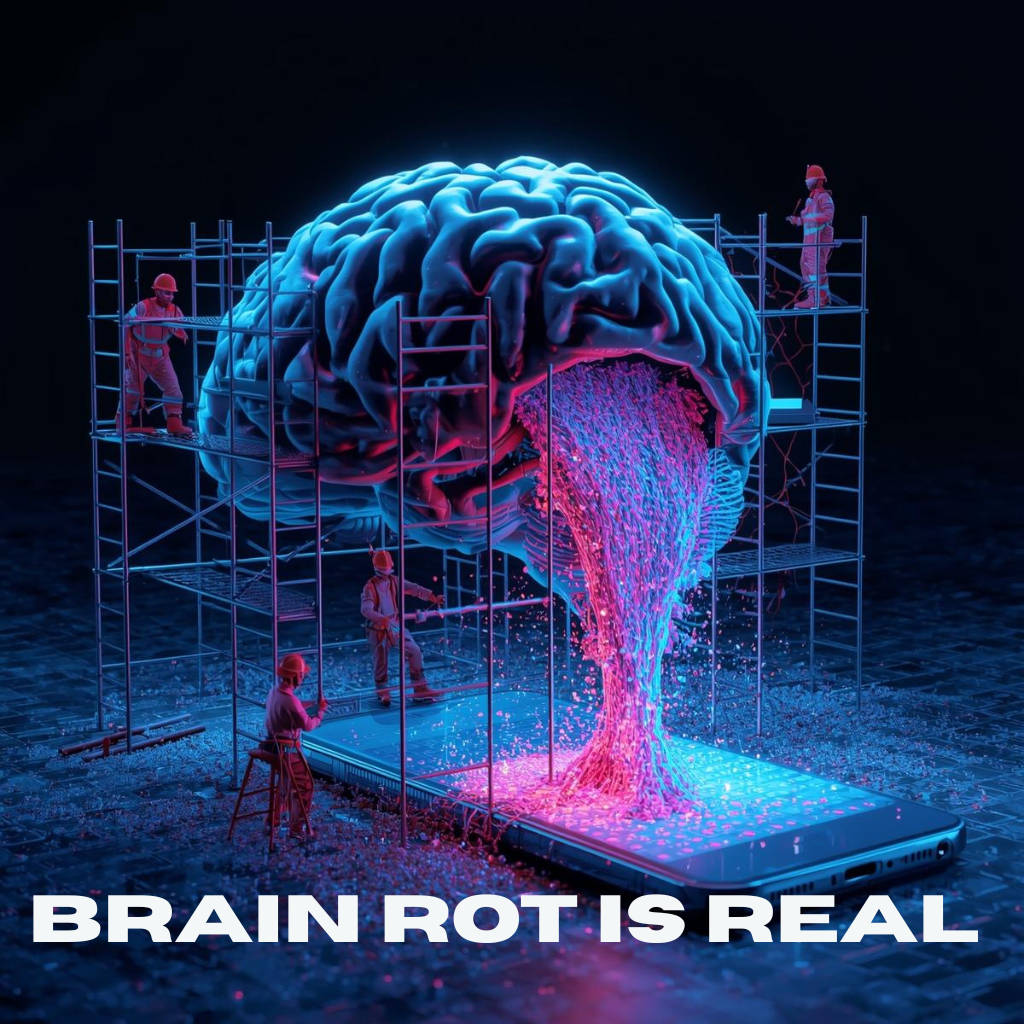
Why “Brain Rot” is Real (and Why It’s Sabotaging Your Recovery)
I want to start with a question that might seem rude, but bear with me: How long has it been since you finished a book?
Not a blog post. Not a magazine article. A real, chunky, requires-actual-commitment book.
If the answer is “I can’t remember,” or “I try, but I just fall asleep,” or “I start, but then I pick up my phone to check one notification, and suddenly it’s three hours later, and I’m watching a video of a hydraulic press crushing a watermelon,” then we need to talk.
We need to talk about “Brain Rot.”
It sounds like a term invented by Gen Z on Reddit to describe a hangover. Still, a massive new systematic review – we’re talking 98,000 participants massive has just confirmed what we’ve all secretly suspected. Short-form video (SFV) content isn’t just a way to kill time. It might actually be killing our ability to think.
As a stroke survivor, I take this personally. My brain is my currency. It is the engine of my recovery. I have spent years on the long road ahead, fighting for every inch of neural pathway, trying to rewire a house where the lights went out.
So, when I read that scrolling through TikTok, Instagram Reels, or YouTube Shorts is actively working against the very cognitive functions I am trying to rebuild, I don’t just see a “bad habit.” I see an enemy.
Let’s dive into the science, the scary stuff, and most importantly, how we get our brains back.
The Science of the Scroll (Or: Why You Can’t Focus)
Let’s get the nerd stuff out of the way first, because knowledge is power, and also because I want you to know I’m not just being a grumpy old man yelling at a cloud.
A major new study titled Feeds, Feelings, and Focus (Nguyen et al., 2025) analysed data from 71 different studies involving nearly 100,000 people. The researchers wanted to know how short-form videos (SFVs) – loops of 15 to 60 seconds that we consume like popcorn – impact our cognitive and mental health.
The results? Well, they aren’t pretty.
The study found a “moderate, negative” association between SFV use and cognition. In plain English: The more you scroll, the worse your brain performs.
Specifically, the study pinpointed two areas of our cognition that take the biggest hit:
- Attention: Our ability to focus on one thing for an extended period.
- Inhibitory Control: Our ability to stop ourselves from doing something impulsive (like eating that second slice of cake, or… picking up the phone to scroll more).
For a stroke survivor, these aren’t just “nice to have” skills. They are the bedrock of rehabilitation. When you are relearning to walk, or speak, or use a fork, you are relying entirely on attention (to focus on the movement) and inhibitory control (to stop the wrong movement from happening).
The “Habituation” Trap
Why does this happen? The researchers point to a concept called the “dual theory of habituation and sensitisation”.
Think of it like this: Your brain is lazy. (Sorry, it is. Mine is too. It wants to conserve energy. When you bombard it with fast-paced, high-stimulation videos, loud music, quick cuts, bright colours – your brain eventually goes, “Okay, this is the new normal.”
It becomes habituated. It gets desensitised to slower, “boring” things.
The problem is that real life is “boring.”
- Reading a book is slow.
- Having a deep conversation with a partner is slow.
- Stroke recovery exercises? They are agonisingly slow.
If your brain has been trained by algorithms to expect a dopamine hit every 15 seconds, a 45-minute physical therapy session feels like torture. Your brain loses its “cognitive endurance”. You literally forget how to be bored, and consequently, you forget how to do the deep work required to heal.
The Dopamine Slot Machine
We need to talk about why we do it. Why do we scroll?
We are not stupid. We know that watching 400 videos of people dancing or baking bread isn’t “productive.” But we do it because these apps are designed to be the world’s most efficient slot machines.
The study highlights that SFV platforms rely on “algorithmically curated rewards”. You swipe up. It could be a boring ad. Swipe. It could be a video you’ve seen before. Swipe. BOOM. A video that makes you Laugh Out Loud!.
That unpredictability triggers a dopamine release in your brain. It is the exact same mechanism that keeps a gambler at the roulette table.
But here is the kicker: The study suggests that this “sensitisation” reinforces impulsive behaviour. The more you give in to the urge to swipe, the weaker your inhibitory control becomes. It’s a feedback loop from hell.
- You feel a twinge of boredom or anxiety.
- You swipe for relief.
- Your brain gets a hit of dopamine, but your attention span shortens.
- Real life feels even more complicated and more boring by comparison.
- You feel more boredom or anxiety.
- Repeat.
This is why the study found that addiction measures (feeling like you can’t stop) had the strongest negative link to mental health, stronger than just the amount of time spent. It’s not just about the minutes you lose; it’s about the control you lose.
The Mental Health Toll: It’s Not Just “In Your Head”
If the cognitive stuff wasn’t bad enough, let’s look at the emotional cost.
The researchers found that increased SFV use is associated with poorer mental health across the board. The strongest links were found with stress and anxiety.
This seems counterintuitive, right? We usually scroll to relieve stress. We come home from a hard day, maybe we’re exhausted from rehab or work, and we think, “I just need to turn my brain off.”
But the data suggests we aren’t turning our brains off; we are revving them up with anxiety.
The study proposes that this happens because we are replacing real-world interactions and emotional regulation with “passive digital engagement”. Instead of processing our emotions – which is a massive part of the stroke recovery journey, we are numbing them.
And interestingly, while the study showed links to depression and anxiety, it found no consistent link between SFV use and body image or self-esteem. This was surprising, as we usually assume social media makes us feel ugly. But it seems the real damage isn’t necessarily that we hate how we look; it’s that we hate how we feel and how we think.
Why This Matters for “The Long Road Ahead”
If you are reading this blog, you are likely someone who cares about resilience. You might be a stroke survivor, a caregiver, or just someone trying to navigate the messy business of being human.
We often talk about recovery in terms of significant milestones: The first step without a cane, the first clear sentence, the return to work.
But I argue that recovery is actually built in the micro-moments. It is built in the ability to sit with frustration without distracting yourself. It is built in the ability to focus on a repetitive exercise for the 500th time because you know it matters.
Short-form videos are the anti-neuroplasticity.
Neuroplasticity… the brain’s ability to rewire itself – requires Focus, Effort, and Repetition.
- TikTok trains Distraction.
- TikTok encourages Passivity.
- TikTok offers Novelty over repetition.
If you are a stroke survivor, your brain is already working overtime to filter out noise and process information. When you flood it with the digital chaos of an infinite scroll, you are adding a weighted vest to a marathon runner.
The study specifically noted that heavy users showed reduced brain activity (specifically the P300 marker) during attention tasks. Their brains literally stopped firing as effectively when asked to focus.
We cannot afford that. We have fought too hard to get our brains back to let an algorithm rot them away.
How to Reclaim Your Brain (Actionable Advice)
Okay, enough doom and gloom. I’m not telling you to throw your smartphone in the ocean (though, honestly, tempting). We should treat our attention with the same respect we treat our physical diet.
Here is how we get back on the right path:
1. The “Friction” Rule
The study showed that “general SFV use” (i.e., just using the apps) is strongly associated with poor outcomes. The problem is accessibility.
- The Fix: Delete the shortcuts. Move Instagram, TikTok, and YouTube off your home screen. Bury them in a folder on the last page of your phone. Make it hard to reach them. If you have to tap the app four times to open it, your “inhibitory control” has a fighting chance to kick in and say, “Hey, do we really want to do this?”
2. Practice “Slow” Boredom
We need to retrain our brains to tolerate a lack of stimulation. This is essentially “cognitive rehab.”
- The Fix: Pick one activity a day that involves zero screens. Read a physical book. Do a puzzle. Sit on your porch and just… look at the trees. Start with 10 minutes. It will feel uncomfortable. You will feel the urge to check your phone. That urge is the weakness leaving your brain.
3. The “Create vs. Consume” Ratio
The study found that different types of engagement matter. Passive scrolling is the enemy.
- The Fix: If you must use these platforms, use them to create or connect, not just to consume. Send a specific video to a friend and message them about it. Engage. Don’t just let the algorithm wash over you like a firehose.
4. Sleep Hygiene (The Non-Negotiable)
The review highlighted that SFV use before bed disrupts sleep quality due to blue light and cognitive arousal. Sleep is when your brain heals. It is when neuroplasticity cements the lessons of the day.
- The Fix: No short-form video 60 minutes before bed. Period. Buy an old-school alarm clock so you don’t have an excuse to have your phone on your nightstand.
5. Mindful Observation
This is for my fellow stroke survivors. When we scroll, we disassociate from our bodies.
- The Fix: When you feel the urge to scroll, do a body scan instead. How does your affected side feel? Are your shoulders tense? Ground yourself in your physical reality. It connects you back to your recovery rather than distracting you from it.
The Bottom Line
The road to recovery “The Long Road Ahead” is paved with intention.
It is easy to fall into the trap of thinking that because we have suffered a medical trauma, we “deserve” the mindless break that TikTok offers. And sure, a little bit is fine. I enjoy a funny dog video as much as the next person.
But we must be honest with ourselves. There is a difference between resting and rotting.
The research is clear: These platforms are not neutral. They are taking something from us our focus, our calm, and our mental endurance that we desperately need.
Recovery is hard. Life is hard. It requires a brain that can handle “hard.” So, do yourself a favour. Put the phone down. Pick up a book, or a weight, or a conversation.
Your brain will thank you for it.
[Source: Nguyen, L., et al. (2025). Feeds, Feelings, and Focus: A Systematic Review and Meta-Analysis Examining the Cognitive and Mental Health Correlates of Short-Form Video Use. Psychological Bulletin, 151(9), 1125-1146.] – https://psycnet.apa.org/fulltext/2026-89350-001.pdf
 The Long Road Ahead
Leave a comment