
If you’ve ever tried to brush your teeth with your non-dominant hand, you know it feels like trying to write a sonnet while wearing boxing gloves. It’s clumsy, it’s frustrating, and you mostly just end up making a mess.
Now, imagine that feeling applied to everything.
Tying a shoelace. Buttering toast. Typing a text message. Walking to the fridge.
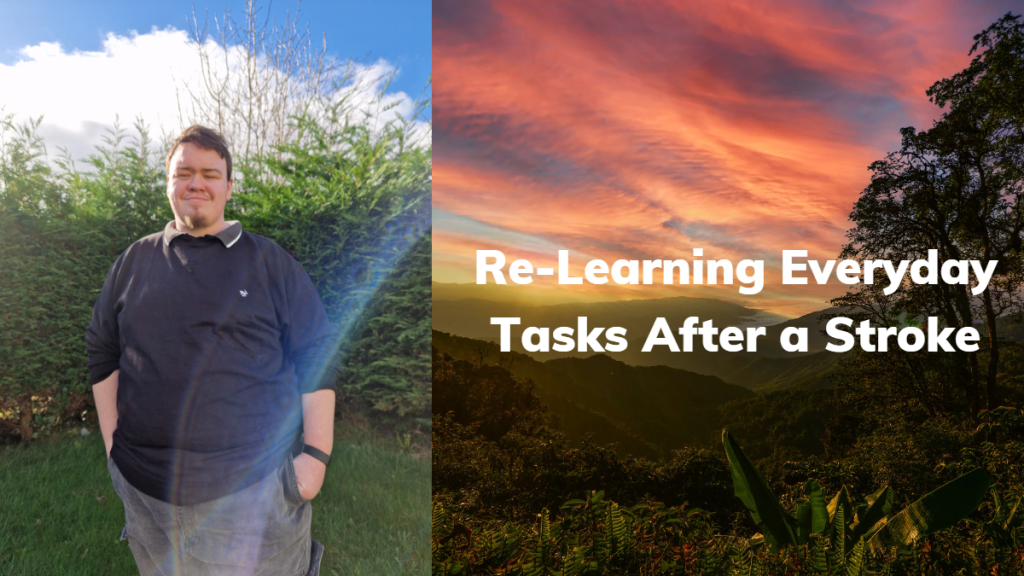
Welcome to my life at age 22.
When I had my stroke, the universe essentially decided to pull the power cord on the left side of my body. One minute, I was a typical twenty-something with the world at my feet; the next, I was lying in a hospital bed, staring at a left arm and leg that felt less like parts of me and more like heavy, unresponsive furniture I was forced to carry around.
At first, I felt like my life was over. The script I had written for my future—the career, the adventures, the “normalcy”—had been shredded. I couldn’t imagine how I was going to cope with the physical limitations that I now faced.
But here’s the spoiler alert: I did cope. And not only did I cope, I learned a secret that most people spend a lifetime trying to figure out.
Big things are just a lot of little things glued together.
If you follow this blog, you know I’m a fan of James Clear’s concept of “Atomic Habits” and the power of compound interest. Usually, we apply these ideas to things like getting rich or getting fit. But what happens when you apply them to simply existing?
Re-learning everyday tasks after a stroke is the ultimate lesson in compound interest. It is a daunting, messy, and exhaustingly slow process. But with time, patience, and perseverance, it is possible to adapt to a new reality.
Here is the data, the stories, and the strategy for rebuilding a life, one tiny task at a time.
The “Wait But Why” Reality: Your Brain is a Jungle
To understand why re-learning tasks is so complicated, we have to get a little nerdy (in a Tim Urban, Wait But Why sort of way).
Imagine your brain is a dense jungle. Over your first 22 years of life, you hacked out super-efficient highways through that jungle. When you wanted to pick up a coffee cup, your brain didn’t have to think; it just sent a signal down the “Coffee Highway” at 100 mph. Zoom. Cup in hand.
A stroke is like a landslide that wipes out those highways.
Suddenly, the signal can’t get through. You want to pick up the cup, but the road is gone. You’re standing at the edge of the cliff, yelling at your hand, and your hand is just chilling there, completely ignoring you.
Recovery isn’t about fixing the old road. It’s about hacking a new path through the jungle, with a machete, while blindfolded.
Every time you try to move your affected limb, you are hacking away a tiny vine. It feels futile. You hack and hack, and the jungle still looks impassable. But if you hack for 100 days? Suddenly, there’s a dirt track. Give it a year? You’ve got a road.
This is the long road ahead. And here is how you walk it.
The Strategy: How to Hack the Jungle
Through my journey—from the hospital bed to where I am now—I’ve boiled down the recovery process into a few core principles. This isn’t just “feel good” advice; this is the tactical framework I used to get my life back.
1. Take It Slow (The 1% Rule)
It’s important to remember that recovery is a process, not a race.
In the early days, I was desperate for speed. I wanted a montage. You know, the movie scene where the hero struggles for 30 seconds to upbeat music, wipes sweat from his brow, and suddenly he’s a kung-fu master.
Real life has terrible editing. The montage takes years.
I had to learn to be patient with myself. You may not be able to do everything you once did right away, but with practice and perseverance, you’ll get there. I had to embrace James Clear’s “1% Better Every Day” philosophy.
If I could move my finger 1% more than yesterday, that was a win. If I could stand for 10 seconds longer, that was a win. When you zoom out, those 1% gains compound into a massive transformation.
2. Become a Cyborg (Use Assistive Devices)
There is a weird stigma around asking for help. We think relying on devices makes us “weak.” Mark Manson would probably tell us that’s our ego talking, and our ego is an idiot.
There are many assistive devices available that can help make everyday tasks easier. Using them isn’t giving up; it’s being smart. It’s upgrading your avatar.
- The Walking Setup: I used a brace on my left leg and a hiker’s stick for most of my days for 3 years. I didn’t hide it. That stick was my Excalibur. It allowed me to navigate the world.
- The Gaming Rig: This is where I got creative. I refused to give up gaming, but standard controllers require two fully functioning hands. So, I engineered a solution.
- I use a Razer mouse with 15 buttons (handling all the inputs my left hand couldn’t handle), and it’s great for games like World of Warcraft.
- I installed foot pedals programmed with custom functions for playing all types of games.
- I utilised Eye-tracking software to control the camera in-game.
I turned myself into a high-tech pilot of my own life. Don’t be afraid to ask your doctor or occupational therapist for recommendations—or get on Reddit and see what the tech community has hacked together.
3. Practice, Practice, Practice (Repetition is King)
Repetition is key when re-learning everyday tasks after a stroke. The more you practice, the better you’ll get.
This goes back to the jungle analogy. The only way to clear that path is to walk it a thousand times.
- The Law of Specificity: If you want to get better at buttoning a shirt, you don’t lift weights; you button shirts.
- The Grind: Don’t get discouraged if you don’t see progress right away. It takes time, but you’ll get there.
I remember days when I spent an hour trying to do something that used to take 5 seconds. It was infuriating. It was boring. But every failed attempt was a signal to my brain: “Hey, we need a new road here. Keep digging.”
4. Stay Positive (The Stoic Approach)
A positive attitude can make all the difference. But let’s clarify what “positive” means.
It doesn’t mean ignoring the suck. It doesn’t mean pasting on a fake smile when you’re in pain. It means what the Stoics called Amor Fati—loving your fate.
Focus on what you can do, not what you can’t. Celebrate small victories. Did you put your socks on by yourself today? That is a victory. Did you walk to the mailbox? Victory.
Don’t be too hard on yourself when things don’t go as planned. Treat yourself with the same kindness you’d offer a friend. If your best friend dropped a glass because their hand spasmed, would you yell at them? No. So don’t yell at yourself.
5. Seek Support (Find Your Tribe)
We are social animals. We are not meant to do this alone.
Don’t be afraid to ask for help. There are support groups and organisations that can provide you with the resources and encouragement you need. Surround yourself with people who believe in you and your ability to recover.
Whether it’s family, a local stroke group, or an online community, finding people who “get it” is invaluable. They are the ones who will remind you how far you’ve come when you feel like you haven’t moved an inch.
The Compound Interest of Experience
Re-learning everyday tasks after a stroke is not easy, but it is possible.
I look back at the 22-year-old version of me—scared, confused, wondering if his life was over—and I wish I could show him where we are now. I wish I could show him the gaming setup. I wish I could show him that hiker’s stick, worn down from miles of walking.
With time, patience, and perseverance, you can adapt to your new reality and live a whole and fulfilling life.
Remember the formula: Take it slow + Use the tools + Repetition + Positivity + Support = The Road Forward.
You got this. The road is long, but the view is getting better every day.
 The Long Road Ahead
Leave a comment