
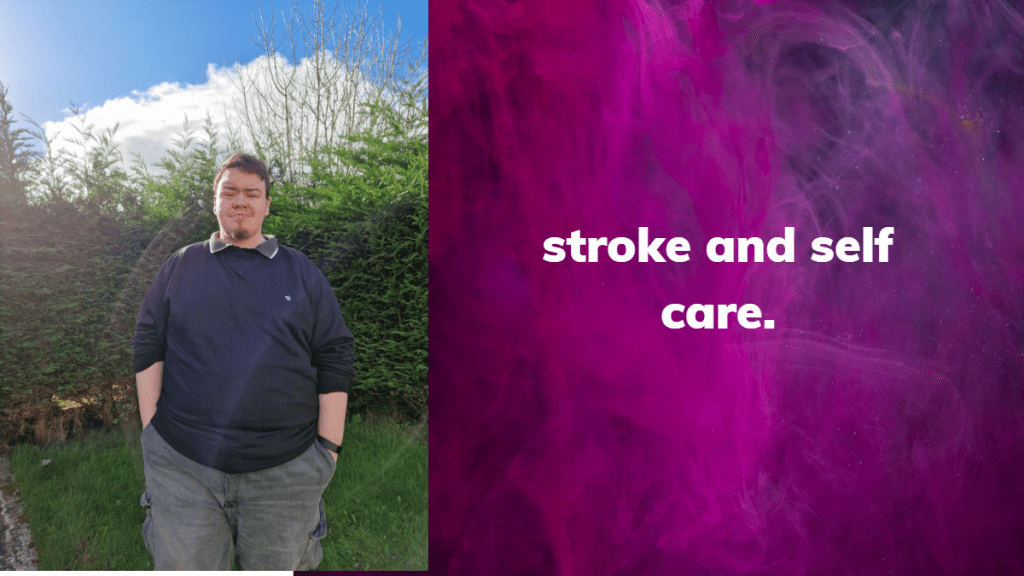
If you had asked me six years ago what “self-care” meant, I probably would have pictured a spa day, a glass of expensive scotch, or perhaps simply turning my phone off for an hour. It was a luxury. It was a bonus round.
Then, five years ago, my brain decided to throw a neurological coup d’état.
When I had my stroke, which took my left side offline and sent my life into a tailspin, the definition of self-care didn’t just change; it evaporated and had to be reconstituted from scratch. Suddenly, self-care wasn’t about luxury. It was about maintenance.
Imagine you are driving a reliable, slightly older sedan. You change the oil occasionally, but mostly you just drive. Then, overnight, you wake up and you are piloting a complex, experimental spaceship that is missing half its buttons, leaking fuel, and the manual is written in a language you don’t speak.
That is the life of a stroke survivor.
It has been five years of navigating stroke recovery, and if I have learned anything, it’s that waiting for the “old you” to come back is a waste of time. The old you is gone. The new you is here, and this new version requires a very specific, very disciplined operating system to function.
We often talk about recovery in terms of doctors and pills. But the real work? The work that determines whether you just survive or actually live? That happens in the quiet moments of self-care.
Here is what I have learned about keeping the machine running on the long road ahead.
1. The Fuel: Eating for a Brain Under Construction
Let’s channel our inner James Clear for a moment. We know that “you are what you eat,” but for us, it’s more like “your neuroplasticity is what you eat.”
After the stroke, I realized that putting garbage fuel into a damaged engine was a recipe for disaster. If you are trying to rebuild neural pathways—literal bridges inside your skull—you cannot build them out of sugar and processed slime.
The science is annoying but irrefutable. High sugar and saturated fats increase inflammation. Inflammation is essentially your body’s way of setting itself on fire to fight an intruder. When your brain is already trying to heal, the last thing it needs is a systemic forest fire.
The Strategy:
I don’t believe in strict, miserable diets. I believe in data.
- The “MIND” Diet: Research suggests a hybrid of the Mediterranean and DASH diets lowers the risk of brain decline.
- The 80/20 Rule: I aim for 80% whole foods—fruits, vegetables, lean proteins, and whole grains. The stuff that grew in the ground or had a mother.
- The 20% Reality: The other 20%? Life happens. Sometimes you need a cookie. Just don’t let the cookie become the meal.
Actionable Insight: Don’t overhaul your fridge overnight. Add one brain-friendly food to your plate tomorrow. Maybe it’s a handful of walnuts (omega-3s are gold) or a side of spinach. Compound interest applies to nutrition, too.
2. The Mechanics: Exercise as a Non-Negotiable
Physical therapy is the boot camp. But what happens when boot camp ends?
Here is the Mark Manson truth: Your body naturally wants to be lazy. It wants to sit on the couch, protect its energy, and watch Netflix. This is doubly true when moving your body feels like trying to pilot a remote-control car with a dying battery.
My left side and I have a complicated relationship. Sometimes it cooperates; sometimes it acts like a sullen teenager. But I realized early on that if I stopped moving, the rust would set in immediately.
Exercise after a stroke isn’t about getting shredded for Instagram. It’s about telling your brain, repeatedly, “Hey, remember this leg? We’re still using it. Don’t delete the software driver for ‘Walking’ yet, please.”
The “Movement Menu”:
Even if you are in a wheelchair or have limited mobility, you have to move the parts that work to support the parts that don’t.
- Strength: You need muscle to carry the weight of your recovery.
- Flexibility: Spasticity (tight muscles) is the enemy. Stretching is the antidote.
- Balance: This is the superpower that keeps us off the floor.
The Tim Urban “Panic Monster“:
I used to wait for motivation to exercise. That’s a trap. Motivation is a flaky friend who cancels dinner plans at the last minute. Instead, rely on Habit. I exercise not because I want to, but because it’s Tuesday.
3. The Operating System: Mental Health and the “Invisible” Load
Let’s get real. Having a stroke is traumatic.
There is a specific type of grief that comes with losing function. It’s not a death, but it is a loss. For the first year, I oscillated between determination and a dark, heavy fog.
Anxiety and depression are statistically very common in stroke recovery. Your brain chemistry has been altered, and your life circumstances have shifted violently. Ignoring your mental health to focus solely on your physical arm movement is like painting the shutters on a house that is burning down from the inside.
Debugging the Mind:
- Talk Therapy: There is no trophy for suffering in silence. Talking to a professional isn’t weakness; it’s strategic planning.
- Mindfulness/Meditation: This sounds woo-woo, but it’s biological. Meditation thickens the prefrontal cortex—the part of the brain responsible for emotional regulation. It’s like doing bicep curls for your patience.
- Acceptance: This is the hardest one. You have to accept where you are today to get to where you want to be tomorrow. Fighting reality just wastes energy.
4. The Reboot: Why Sleep is Your Secret Weapon
In the hustle culture of the 21st century, sleep is for the weak. In the world of stroke recovery, sleep is for the smart.
When you sleep, your brain literally cleans itself. The “glymphatic system” opens up and washes away metabolic waste. If you are a stroke survivor, your brain is working overtime just to process basic inputs. It is running a marathon while everyone else is walking. It needs the downtime.
I used to feel guilty about napping. Now, I view it as a system update. You know when your computer gets laggy and weird, and you restart it, and suddenly it works again? That’s you. You are the computer.
Sleep Hygiene 101:
- Darkness: Pitch black room.
- Temperature: Keep it cool.
- The Phone Ban: Blue light messes with melatonin. Put the phone away an hour before bed. Read a book. Talk to your spouse. Stare at the ceiling. Just don’t scroll.
5. The Network: Connection is Medicine
One of the cruelest ironies of a stroke is that right when you need people the most, you often feel the least like socializing. You might have aphasia (difficulty speaking), or you might just be tired. The temptation to withdraw into a turtle shell is immense.
But isolation is a killer. Literally. Loneliness triggers the same stress hormones as physical danger.
Staying social doesn’t mean you have to go to loud parties. It means maintaining the tether to humanity. It means letting people in, even when you feel messy and unpolished.
The Strategy:
- Micro-dosing Socializing: If a dinner party is too much, do a 15-minute coffee.
- Digital vs. Analogue: Social media is okay, but face-to-face (or voice-to-voice) is better. A “like” is a hit of dopamine; a conversation is a hit of oxytocin.
- Support Groups: There is a unique magic in talking to people who get it. When you say, “I’m tired,” a non-stroke survivor thinks you need a nap. Another survivor knows you mean “My brain feels like it’s moving through molasses.”
The Compound Effect of Survival
Here is the bottom line.
Recovery is not a montage in a movie. There is no rock music playing while you suddenly learn to walk perfectly in three minutes. It is a slow, grinding, nonlinear process.
There will be days when you eat the pizza, skip the gym, and cry in the shower. That is okay.
The goal of self-care on the long road ahead isn’t perfection. The goal is consistency. It’s showing up for yourself, day after day, even when it’s hard. Especially when it’s hard.
By fueling your body, moving your machine, tending to your mind, prioritizing your rest, and staying connected, you aren’t just “recovering.” You are building a life. A different life, perhaps, but a good one.
You have survived the event. Now, it’s time to thrive in the aftermath.
Keep moving. Keep fighting. And remember to be kind to yourself along the way.
 The Long Road Ahead
Leave a comment